
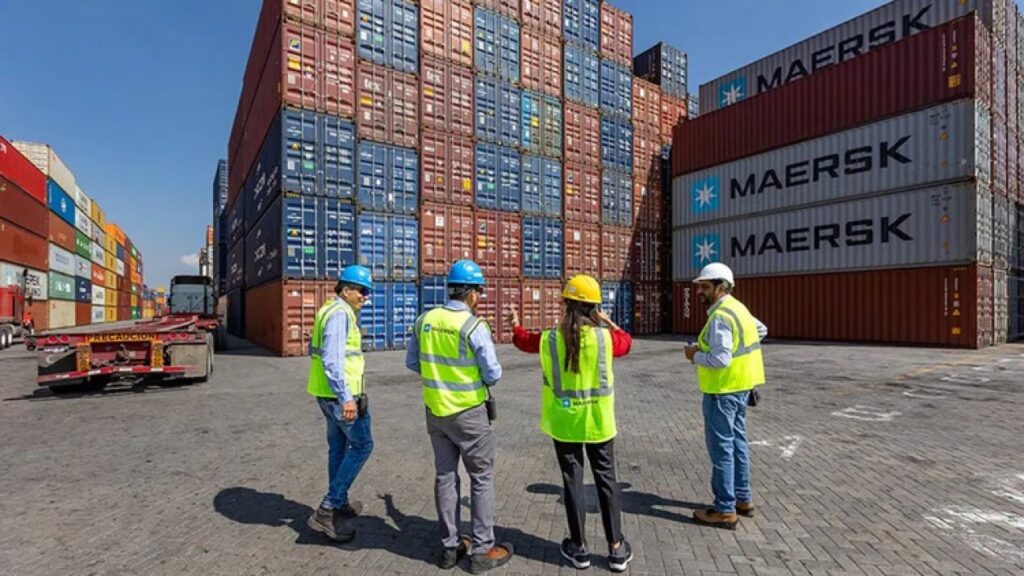
A.P. Moller, Maersk has inaugurated a new logistics depot in Manzanillo backed by an investment of over US$15 million, as the company moves to deepen its presence in one of the country’s most critical trade gateways. Located about 5km from the Port of Manzanillo, Mexico’s busiest container hub, the facility is designed to accelerate cargo flows, reduce first- and last-mile friction, and strengthen supply chain resilience across the Pacific corridor.
“Manzanillo is one of Mexico’s most dynamic trade hubs, and this investment underscores our commitment to the country’s long-term growth. By offering integrated services — from shunting to transloading and reefer support — we are helping customers simplify their supply chains and strengthen their competitiveness in both domestic and international markets,” says Patricia Perez, Managing Director, Maersk in Mexico.
The new depot spans 31,000m² and is built to address congestion pressure points that typically emerge at high-volume ports: terminal truck idling, equipment availability, container handoff delays, and cold-chain constraints for refrigerated cargo. Maersk positions the site as a practical “agility layer” outside the terminal, enabling shippers to move cargo through Manzanillo with more predictable timelines and lower operational volatility.
Manzanillo’s role in Mexico’s trade architecture continues to expand, particularly as a primary entry point for Asia-linked cargo that then moves inland to the Bajío and the central industrial corridor. The port’s scale and geography make it a natural consolidation hub for imports feeding automotive, electronics, retail, and other manufacturing-heavy supply chains that rely on consistent container availability and fast inland distribution.
According to Maersk, the facility has capacity for 6,018 TEUs, includes 50 reefer plugs, and provides 60 repair positions. It is set up to manage dry cargo, refrigerated units, gensets, and 53ft boxes, supporting both standard container workflows and transloading operations into domestic distribution equipment.
Beyond storage, the facility offers:
-
Shunting services aimed at reducing truck idling and easing terminal-side congestion by improving the cadence of moves to and from port terminals
-
Transloading for dry and refrigerated cargo, including transfers into 53’ boxes and other inland configurations, while maintaining cold-chain integrity for temperature-sensitive freight
-
Container management to better sequence reception and delivery, helping customers align yard capacity, warehouse space, and inventory timing
-
Maintenance and repair for dry and reefer equipment to keep assets operational and reduce disruption from damaged units.
“The last mile is one of the most critical — and most challenging — links in today’s supply chains. Delays and costs are not only disrupting operations but also mean missed opportunities for our customers. With this new facility in Manzanillo, we are creating agility where it matters most — reducing logistics costs, accelerating transit times, and giving businesses better control over their cargo. Ahead of Mexico hosting important global events in 2026, we are ready to cater to the surge in demand across retail, lifestyle, and technology sectors, ensuring our customers stay ahead of the game,” says Getulio Centanaro, Head of Logistics and Services, Maersk in Mexico.
Manzanillo’s Investment Cycle Accelerates as Saturation Risks Rise
The Manzanillo depot adds to Maersk’s broader logistics platform in Mexico, which the company says includes more than 59,000m² of warehousing in Mexico City and Tijuana, plus 250,000m² of depot capacity across Cuautitlan, Lazaro Cardenas, and Manzanillo. Maersk also operates air logistics hubs in Mexico City, Monterrey, and Guadalajara, and says it plans to expand capabilities in Guadalajara and Monterrey while strengthening landside infrastructure for Mexico–US cross-border trade.
MBN reports that port authorities and private operators have begun addressing saturation risks through a multi-billion-peso pipeline, including: the Puerto Nuevo development in the Cuyutlán Lagoon (MX$18.7 billion), a PEMEX terminal relocation project (MX$994 million), and major investments in specialized container terminals across two phases (MX$40.9 billion and MX$47.6 billion). Contecon Manzanillo is also tied to projects in San Pedrito, including a mineral terminal rehabilitation and an expansion package.
ASIPONA Manzanillo leadership has emphasized the port’s rising national weight, as Manzanillo mobilized 12% of national cargo tonnage in 2024. SEMAR describes Manzanillo as a cornerstone of Mexico’s logistics and economic trajectory as throughput records and investment commitments scale up.
Private operators have also highlighted the modernization already underway. The private sector has invested over MX$35 billion to upgrade operational capacity, including expanded crane fleets, yard equipment, gates, and rail connectivity linking the port more directly with industrial clusters, supported by a large workforce enabling 24/7 operations.