
Pizza boxes and energy drink cans pile up in dorm trash bins around the University of Kansas campus as evidence of the quick fixes that fuel college life.
While conversations about mental health are at the forefront, the realities of poor nutrition, food insecurity and overlooked physical wellness weigh heavily on students’ daily lives.
At the University of Kansas, students face a quiet struggle: accessing affordable, nutritious food. Rising grocery prices, limited grocery access and demanding academic schedules impact how students eat.
Nutritional challenges often extend beyond bad habits and point to underlying structural issues, such as food insecurity. The U.S. Department of Agriculture defines food insecurity as “a household-level economic and social condition of limited or uncertain access to adequate food.” The Lumina Foundation estimates that one in four of the 47% of college students who do not rely on parental support are living below the federal poverty level.
For students like Elisa Ohler, who graduated from KU in May, affording necessities while attending classes can be difficult.
“I was a full-time student making only $14 an hour who had to afford monthly rent, groceries, some sort of entertainment and also tried to save money throughout my college career,” Ohler said. “There were definitely months where I was barely able to afford groceries after rent.
Ohler’s story is common among college students, according to KU Health Education Resource Office health educator Abby Vaughn. She said limited income and busy schedules often make food insecurity a persistent problem throughout students’ college years.
“A lot of students that experience food insecurity during the college age, it’s like a chronic condition,” Vaughn said. “Some of those economic factors tend to make food insecurity more chronic during those four years that you’re here.”
The university has made efforts to combat food insecurity through campus resources and wellness programs. Located in the Kansas Union’s Student Engagement Center, The Campus Cupboard has provided students, faculty and staff with free nutritious food and household essentials since 2018.
“We hear a lot of talk of people saying, ‘When I was in college, I was on the ramen noodle diet’ and we know that doesn’t lead to a nutritious and balanced life,” said Sarah Grabber, associate director for impact programs and services. “Oftentimes, those things that are included in that nutritious and balanced diet, like fresh produce and veggies, are really hard to access or buy because they’re so expensive.”
Campus resources
The Campus Cupboard operates as a satellite office of Just Food, a community food bank in Lawrence. Grabber said the Cupboard is filled through visits to local food banks and donations from the public. As of spring 2025, the Campus Cupboard sees an average of 680 monthly student visits.
The Campus Cupboard also assists students with applications for the Supplemental Nutrition Assistance Program.

Flyer located around campus provides information to students on how to apply for Supplemental Nutrition Assistance Program benefits.
Another campus resource that addresses nutrition is the university’s Health Education Resource Office, located in Watkins Health Center. HERO supports students’ personal development in enhancing healthy behaviors.
“Our motto is when you feel well, you do well,” HERO health educator Cheleia Marshall said. “We like to base all of our information on research that we’ve done through plenty of college health assessments.”
This semester, HERO is offering two nutrition-based programs led by Vaughn for students: Ask A Nutritionist and Eat Well Live Well.
Ask A Nutritionist is a program where students can ask any questions they have about nutrition. Eat Well Live Well is a six-week behavior change program focusing on student nutrition, mindset and healthy lifestyle.
“We cover different topics relating to [nutrition], like healthy eating out, grocery shopping, things that really apply to the college-aged individual,” Vaughn said.
In 2023, HERO participated in the National College Health Assessment survey. The survey showed 57.4% of KU students said they experienced low or very low food insecurity at some point during college. Now, HERO nutrition programs refer students to food insecurity resources in Lawrence.
Beyond her own experience, Ohler sees the effects of food insecurity in her job as a cashier at Dillons.
“I see people struggle to buy groceries almost on the daily, even with WIC or SNAP benefits,” Ohler said. “The most difficult cases are where a customer intentionally finds items that are supposed to be covered under these food assistance programs but would still be left with an outstanding balance that they aren’t always able to cover.”
Poor nutrition affects daily lives
The impact of nutrition extends beyond meals alone. Students often overlook how poor nutrition affects their lives and influences habits such as sleep and exercise.
“We’re seeing the manifestations of bad lifestyle habits earlier,” said cardiologist Ashley Simmons in a University of Kansas Health System report on college diet habits. “This includes an increase in problems like sleep apnea, high blood pressure and pre-diabetes – problems that can largely be prevented through better, healthier habits.”

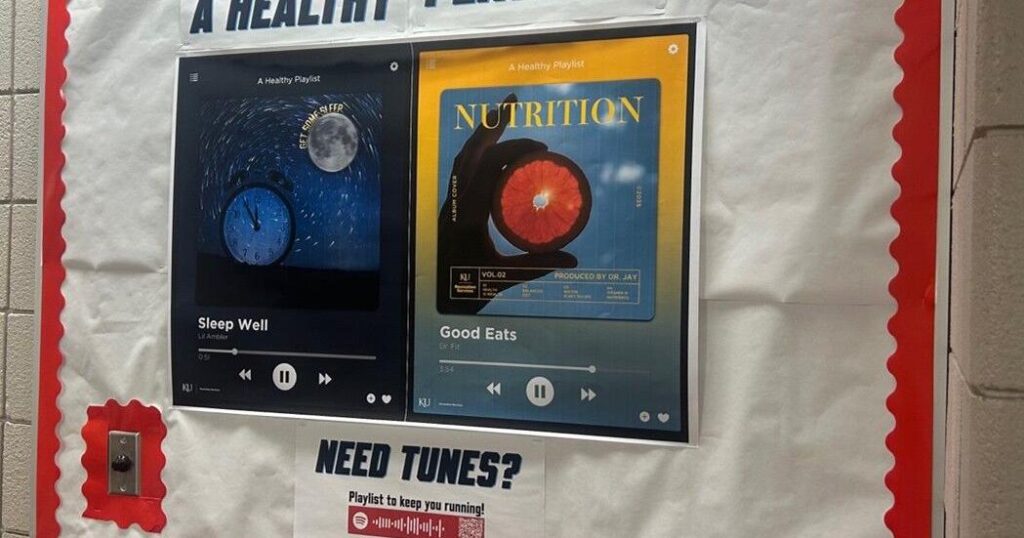
A poster promoting sleep awareness created by students in BIOL 446: Biology of Sleep hangs in Haworth Hall. The posters, located around campus, are created in a class partnership with HERO to promote physical wellness.
HERO’s prevention-based programs aim to improve these lifestyle factors through healthy conversation. This is achieved through promotional messaging around campus. This semester, students in KU’s Biology of Sleep course, taught by Dr. Jennifer Gleason, partnered with HERO to create posters around campus emphasizing the importance of sleep and physical wellness.
As KU continues to address student wellness through programs like The Campus Cupboard and HERO, food insecurity remains a challenge rooted in both economic and structural barriers.
“I always tell folks to give yourself grace,” Marshall said. “Reach out to resources and always communicate to who you need to. Give yourself grace, communicate, be honest with yourself and prioritize day by day.”
Claire Franke is a University of Kansas senior from Shawnee, studying journalism and business.