
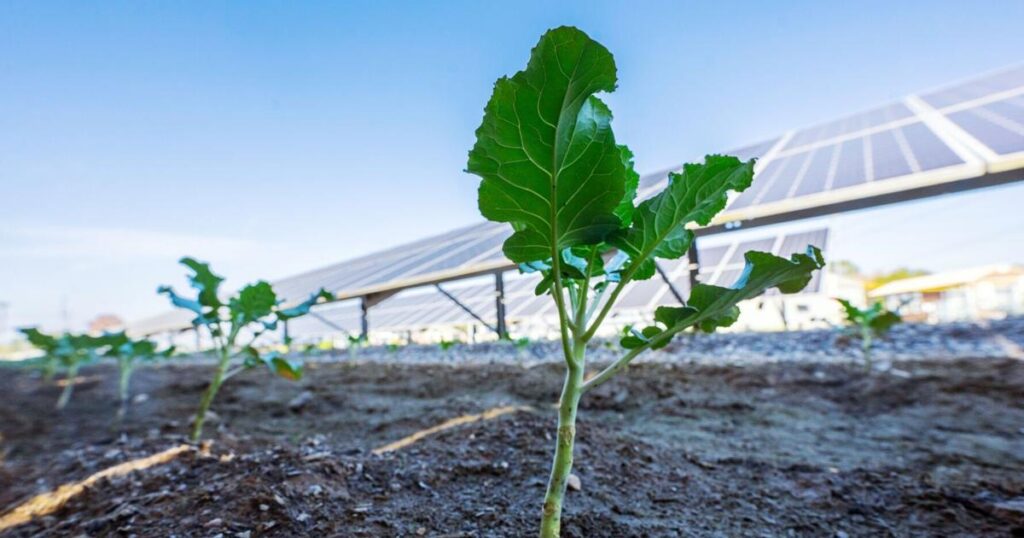
Hundreds of solar panels generate clean energy at the UL Solar Farm, but it’s what’s in between those panels that one researcher hopes will revolutionize Louisiana agriculture.
Vegetable crops have been planted in the shady areas between panels, with the hope they can produce a strong yield. It’s a relatively new idea called agrivoltaics.
Agrivoltaics, or AV, is the science of raising crops — whether livestock or row crops — alongside solar production. In states such as Texas and Arkansas, “solar grazing” has taken off in recent years, partly because livestock can use solar panels for shade while keeping vegetation under control.
Just last month, RWE Clean Energy completed building a solar farm outside Monroe that will generate enough electricity to power 17,000 homes. A flock of about 600 sheep will soon be grazing around the solar panels to keep the vegetation under control.
Virtually no research has been done into AV in Louisiana. Until now.
Caitlin deNux, a visiting professor at the University of Louisiana at Lafayette, is leading the university’s recent research into AV. She formerly worked with the LSU AgCenter at their Crowley research station.
“We’re looking to see if agrivoltaics is viable for Louisiana’s climate and whether the specialty crops are as nutritious when grown in the shade,” deNux said.
But AV isn’t emerging in a vacuum.
Land-use tension
In the past five years, Louisiana has seen hundreds of acres of rural land — often agricultural or pasture — converted into large-scale solar sites, with developers like D.E. Shaw and corporations such as Meta and Amazon driving the expansion.
That growth has collided with longstanding agricultural traditions — particularly in the state’s sugarcane belt — creating a new wave of land-use tension in rural communities.
Plans for solar farms in Iberville and St. James parishes were scrapped following local pushback, in particular from sugar cane farmers who view the initiatives as an encroachment on their own economic viability. In October, members of the Sunset community expressed similar frustrations at a town hall discussing a proposed solar farm on Hippolite Miller Road.
It’s happening nationwide: Farmland is disappearing, and solar development is expanding. The United States loses 2,000 acres of farmland a day to non-agricultural development, and by 2050, solar farms alone are expected to occupy more than 10 million acres — roughly 0.5% of the contiguous United States, according to American Farmland Trust.
With farmland disappearing and solar panels spreading across rural Louisiana, agrivoltaics could offer farmers a way to maintain production while also generating energy.
“The whole premise is really looking at sustainability and dual sources of revenue for producers, which comes from the energy they can sell back to the grid,” deNux said.

Dr. Caitlin deNux, visiting assistant professor in the School of Geosciences, is pictured at the agrivoltaics testbed Monday, November 24, 2025, at the University of Louisiana at Lafayette Solar Energy Laboratory in Lafayette, La. She and University students have planted 424 broccoli plants consisting of Green Magic and Destiny varieties in order to test the potential for agriculture combined with solar energy production and how the two can work together.
Some researchers counter that the expansion of agrivoltaics into Louisiana agriculture should be limited, and would require a long-term investment for what is likely to be a small initial return.
“I don’t see being able to convert 500 acres of sugar cane into 500 acres vegetable crops under solar panels, at least not without a major hit to the farmers or the producer,” said Kurt Guidry, an agribusiness researcher at the LSU AgCenter. “You as a producer would need to get in touch with a buyer willing to purchase at that scale. I’m skeptical of it. It would likely need to be at a much smaller scale.”
Guidry has conducted previous research into the economic consequences of transitioning sugarcane fields into solar farms, warning of possible losses in revenue for the state’s economy.
Due to the size of the plants, sugarcane is not a viable crop for AV, and thus any transition of sugarcane farms into AV farms will require produce to come in the form of different crops.
“Most sugar cane farmers in Louisiana rent their land, and most of our farmers aren’t trained for vegetable crops. So when a landowner decides to transfer land from sugarcane into a solar farm, even if they are growing crops under the panels, unless we’re specifically training those farmers for growing those crops it’s putting people out of a job,” Guidry said.
‘Both sides can be happy’
At UL’s solar farm on Eraste Landry Road, researchers and students under deNux’s guidance have planted 434 broccoli plants in between the solar panels already located there.
While not a major crop in the Louisiana agricultural industry, AV studies have shown broccoli to have a particular propensity for growth using the procedure, which deNux said influenced her decision in choosing the crop for the study.
The study also aims to determine if members of the public prefer the look and taste of produce grown through AV or conventional means by use of a blind sample.
“There’s a South Korean study that showed that broccoli grown in AV plots were a more vibrant green. It’s very fresh-looking when compared with the more dullish green of conventionally grown plants. Customers there preferred the visual appeal and taste of AV grown broccoli. That could increase consumer demand,” deNux said.
The additional source of revenue isn’t the only benefit of transitioning a traditional solar farm into an AV farm either. The presence of crops themselves can benefit energy production according to deNux.
“These plants take water from their roots and release it as vapor, which in turn creates a cooling effect under the panels. Solar panels don’t do as well when they’re overheated, so the plants also make the energy production more efficient.”
While still in its infancy, deNux is hopeful UL’s research will lead to increased exposure and viability for the emerging approach to farming and offer Louisiana’s economy a path toward reduced reliance on fossil fuels.
“It wouldn’t be the first time we’ve made massive changes in agriculture. I think this provides a way that both sides can be happy. When I’ve presented research I’ve gotten a lot of interest from people who want to know how they can implement this on their land. I do believe in sustainable energy, and with climate change getting more unpredictable here in the gulf South having reliable energy sources is important. If we train people, if we do it the right way, this will hopefully be a way of getting there while giving some farmers additional sources of revenue.”