
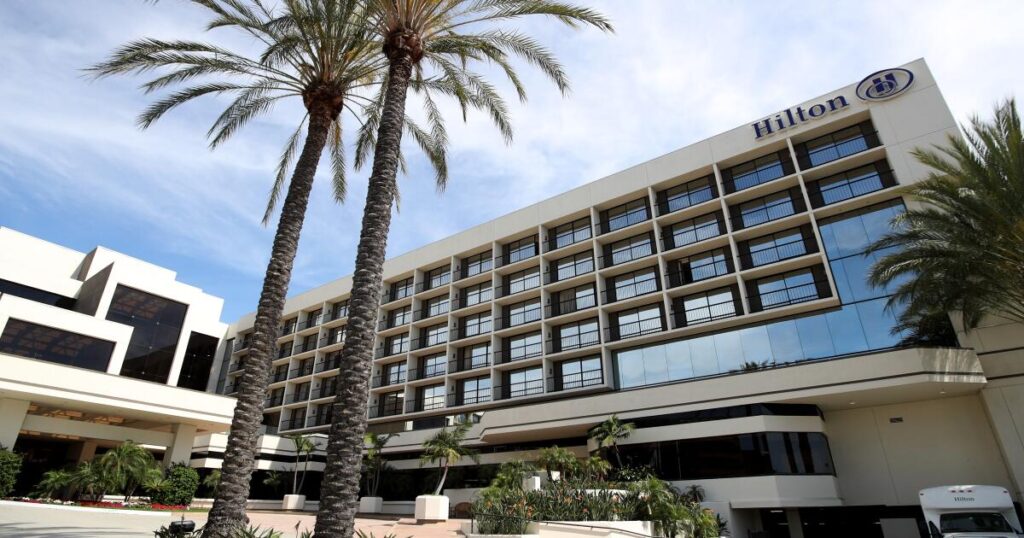
Seeking to bolster the amount of revenue coming into the city, Costa Mesa officials are considering placing a hotel occupancy tax and a possible increase in business license fees before voters next year.
“We haven’t increased the business license tax for 40 years, and certainly costs have gone up,” Mayor John Stephens said. “If the community wants excellent service, we have to have commensurate revenue to pay for that.”
Council members on Tuesday authorized city staff to analyze potential frameworks for implementing the hikes, and their impacts, in coordination with the city’s Finance and Pension Advisory Committee (FiPAC).
One reason for the initiatives is parity, according to finance director Carol Molina. Whenever travelers book a hotel or motel room in Costa Mesa, they are charged 8% of their room rate per day as part of a transient occupancy tax (TOT) that goes back to the city’s general fund to help pay for public services.
The tax was established in 1978 and set at 6%, where it remained for the next 32 years before being increased to 8% in 2010. Past efforts to increase the amount — an idea supported by FiPAC members — went nowhere.
This fiscal year, the city anticipates receiving about $9.8 million from the hotel tax. But even a small hike of 1% could significantly increase city revenues, which have recently lagged, leading to cuts and inspired creative financing solutions.
“Each 1% of transient occupancy tax generates a little bit under $1 million per year,” Molina told the council.
Nearby cities charge much higher rates, including Anaheim, where hotel guests pay 15% of their room cost. Long Beach taxes 13%, Santa Ana, 11% and Newport Beach, 10%.
Costa Mesa similarly falls behind other municipalities in what it charges for business licenses, a fee intended to help cover operational costs, which go up when more businesses, employees and customers come to town.
Cities have different ways of assessing such fees — some charge based on the number of employees, while others, including Costa Mesa, employ a sliding scale based on gross receipts.
But here, too, Costa Mesa lags, with the cost of such licenses remaining the same since it was first instituted in 1985. Consequently, a business with gross receipts between $100,001 and $250,000 today pays $100, compared with the $227 it would pay in Santa Ana.
That disparity increases exponentially for businesses that make millions each year. For example, an operator earning between $1 million and $5 million would pay $200 for a Costa Mesa business license, compared with $475 in Anaheim and $3,314 in Santa Ana. Those with gross receipts between $10 million and $25 million also pay $200 in Costa Mesa, compared with the $2,375 they’d pay in Anaheim and $16,314 in Santa Ana.
Molina estimated that while the city earns roughly $700,900 annually from business license fees, Huntington Beach generates $3 million, Newport Beach, $4.9 million, Anaheim, $7.5 million and Santa Ana, $17.5 million.
She said whatever framework staff were to develop, the emphasis would be on limiting the impacts to small businesses.
The council generally supported raising the transient occupancy tax, but members Mike Buley and Jeff Pettis opposed increasing any kind of fee or tax on businesses, suggesting exploring only a hotel tax hike.
“I’d feel better if we were doing really well and perceived as doing really well with business permitting and licensing, in general,” Pettis reasoned. “But right now I think we have some work to be done on this, so to go ahead and tax them on top of it doesn’t feel right to me.”
But the majority of council disagreed, supporting a plan to review options for both measures. A required five-member supermajority of the seven members has until August to decided whether to place the measures on the November 2026 ballot.