
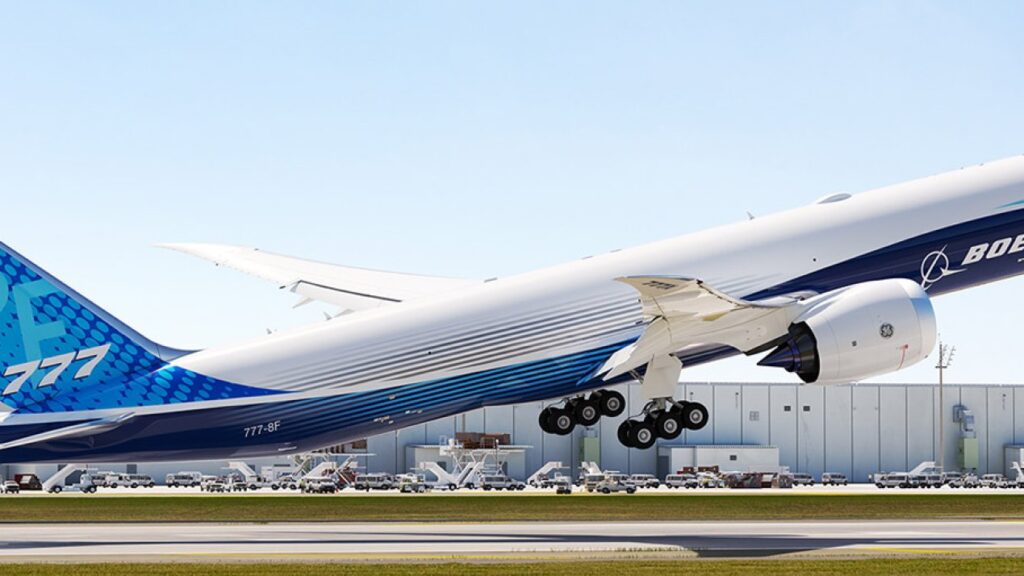
Boeing has asked the Federal Aviation Administration (FAA) to grant a waiver from upcoming aircraft emissions rules to allow the sale of an additional 35 Boeing 777F freighters, citing strong customer demand and delays in certifying its next-generation cargo aircraft. The request, submitted on Dec. 19, seeks approval by May 1, the company said.
The emissions standards are scheduled to take effect in 2028 and will apply to most large aircraft operating in US airspace. Boeing said the next-generation 777-8 Freighter, which is expected to comply with the new limits, will not be ready before the rules come into force. The waiver, the company said, is intended to bridge the gap until the 777-8F enters service.
Boeing expects to deliver the first 777-8F about two years after the initial delivery of the 777-9 passenger jet, which is currently targeted for 2027. “The waiver would allow Boeing to meet anticipated customer demand for cargo aircraft prior to the 777-8F entering service,” the company said.
Widebody cargo aircraft have become one of the most constrained assets in aviation as demand continues to outpace supply. Growth in e-commerce, volatility in maritime shipping and efforts to build more resilient global supply chains have pushed air cargo demand beyond pre-pandemic levels. At the same time, new freighter programs are running behind schedule. Airbus is facing similar timing pressures with its A350 freighter program, while older MD-11 aircraft are being retired following safety concerns. Boeing said this combination of delays and retirements has created a near-term capacity gap that cannot be filled quickly.
The FAA finalized the emissions rules in February 2024 under President Joe Biden, adopting international standards aimed at reducing carbon emissions from aviation. Aircraft already in service before 2028 are exempt. Boeing’s request applies only to newly built 777F freighters that would otherwise fall under the regulation.
Boeing argued that large widebody freighters play a critical role in global trade. “Of the US$600 billion in goods exported by air cargo in 2024, more than US$260 billion were transported on large widebody freighters,” the company said. It added that each 777F exported to a foreign customer contributes about US$440 million, at catalog value, to the US trade balance, warning that more than US$15 billion in export value could be lost if the waiver is denied.
The company also said the 777F remains the most fuel-efficient aircraft in the global freight market and is currently the only large widebody freighter in production. Boeing has received significant orders from cargo operators as demand for dedicated freighters has remained strong following supply chain disruptions and sustained growth in e-commerce.
Congress has previously intervened on similar issues. In 2024, lawmakers approved legislation allowing Boeing to continue producing the 767 freighter through 2033, exempting it from the same efficiency rules scheduled to take effect in 2028.
According to the FAA, civil aviation accounts for about 9% of domestic transportation emissions and roughly 2% of total US carbon emissions. The Biden administration has set a target of achieving net-zero greenhouse gas emissions from the US aviation sector by 2050, intensifying regulatory pressure on manufacturers and underscoring the tension between long-term climate goals and near-term industry demand.