
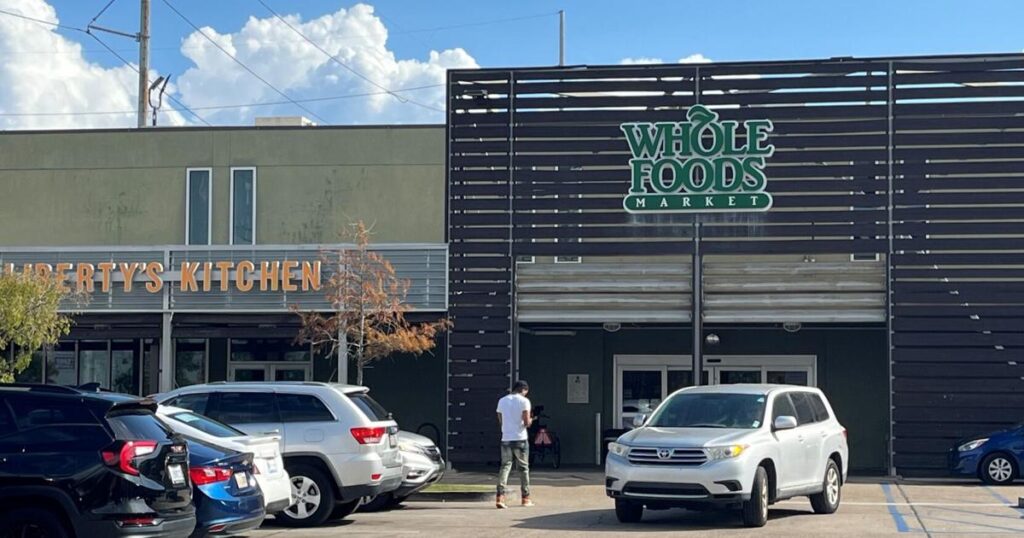
The shopping center at 300 North Broad St. that is home to a Whole Foods Market has been sold by its longtime nonprofit owners to a family of Marksville investors, who say they plan to continue operating the center as a health hub for the area.
Broad Community Connections, the New Orleans nonprofit that developed the center in 2014 as a way to bring fresh food to the area and spur neighborhood revitalization, finalized the sale of the property to brothers Byron and Jacques Goudeau on Friday. The price was not disclosed.

The Whole Foods Market at 300 N. Broad. St.
The Goudeaus have extensive business interests in truck stops, convenience stores, video poker and RV resorts, according to information provided by the family. They also operate several nonprofits, including an early childhood learning center, and established Main Street Marksville, a downtown revitalization initiative.
In a prepared statement, the brothers said they intend to honor the center’s long-term leases, which, in addition to Whole Foods, include several nonprofits focused on health, education and nutrition.
“As a mission-driven owner, we embrace the responsibility that comes with investing in this central hub of community efforts,” the statement said.
The brothers said they also intend to find “complementary tenants” to fill a space in the building vacated earlier this summer by Liberty’s Kitchen, and plan to make repairs to the structure.
“We feel that our role as a property owner is to be an active participant in the betterment of the facility,” the statement said.
A good fit
Broad Community Connections is a Main Street organization, part of a broad network of nonprofits focused on revitalizing downtown and inner city corridors through economic development programs and preservation. Founded in 2008, the organization has centered on North Broad Street and Bayou Road.

A sign for the ReFresh Center at 300 N. Broad St., anchored by Whole Foods Market.P
In 2011, it bought the 60,000-square-foot former Schwegmann’s Supermarket for $2.4 million with help from the city and another nonprofit partner, L+M Development Partners, a New York-based firm that specializes in low-income and market-rate housing.
It converted the property into the $20 million ReFresh Project, a health hub whose other tenants included the Goldring Center for Culinary Medicine, FirstLine Schools, and Boys Town, as well as the Liberty’s Kitchen, which trained young people to work in the hospitality and food-service sectors.
The idea, Broad Community’s Executive Director Dasjon Jordan says, was to bring together nonprofits that all had “some kind of impact across the social determinants of public health.”
In 2020, another nonprofit, Alembic Community Development, which specializes in affordable housing development, bought out L+M’s stake in the project and has co-owned it with Broad Community ever since.
Alembic Principal Jonathan Leit said his group had been approached about selling the property several times over the years but that none of the interested buyers was a good fit.
The Goudeaus, in contrast, were aligned with Broad Community’s and Alembic’s mission for maintaining a hub that will serve the neighborhood’s needs on many levels.
“They were a good fit,” Leit said. “They are committed to doing this right.”
The Goudeaus said in their statement they hope to “honor the work that has already been done, and to grow genuine relationships with the nonprofits, companies, and community organizations that call the property home.”
‘Ongoing conversation’
When Broad Community Connections first bought the property in 2011, the city was in the throes of a post-Hurricane Katrina revitalization that was bringing back long-neglected corridors across the city.
St. Claude Avenue, Oretha Castle Hailey Boulevard, Freret Street and South Rampart Street all were showing signs of new life, signaling hope for the city’s future.
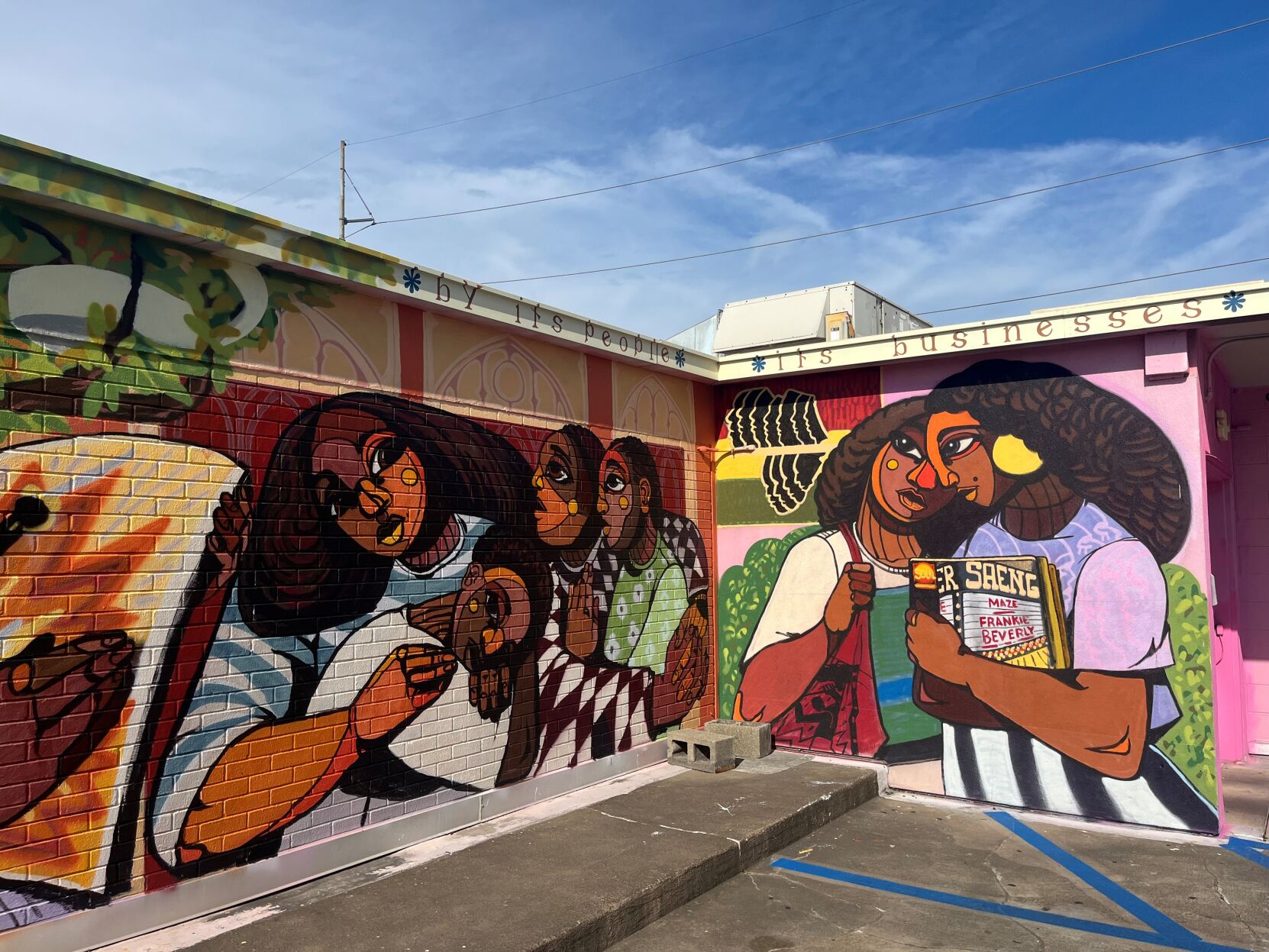
A mural by local artist Langston Alston on the second floor exterior of the Whole Foods Market building at 300 N. Broad St., which recently changed hands.
Jeff Schwartz, then Broad Community Connection’s Executive Director who went on to serve as the city’s economic development director under Mayor LaToya Cantrell, suggested North Broad could be next, saying in 2012, “We want to make Broad Street a place where people want to linger and mingle.”
More than a decade later, Jordan said the organization and the ReFresh project have achieved many of their goals. The Whole Foods does a brisk business with a loyal and diverse customer base. Outside from Liberty’s Kitchen, the other tenants in the center have done well.
A half mile away, high-end coffee shops like LaMara and trendy eateries like Ruby Slipper co-exist with longtime local businesses like nail salons and tattoo parlors. There are also discount stores and a lot of blighted properties.
Jordan said there is still much work to be done and that proceeds from the recent sale of the Whole Foods property will enable his organizations and others like it to expand their reach.
“We know we will be able to use the funds for more investments along the Broad Street corridor,” he said. “We are also looking to other nearby neighborhoods.”
He said the goal is to attract new investment while resisting displacement.
“What does investment without displacement look like? I think shared ownership is a partial answer to that,” he said. “We have bene able to hold that diversity but it is an ongoing conversation we need to continue to have.”